





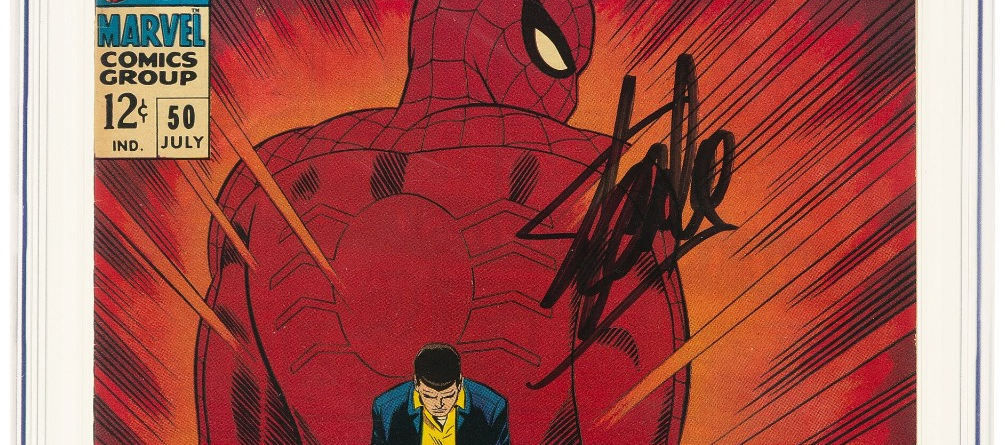

Amazing Spider-Man #50 (1967) CGC 8.5, Signed by Stan Lee & John Romita Sr.
A Cornerstone of Silver Age Marvel History**
Few comic books transcend their medium to become true cultural artifacts. Fewer still manage to unite historic storytelling, iconic artwork, character-defining themes, and legendary creators in a single issue. Amazing Spider-Man #50, published in July 1967, is one of those rare books. When preserved in CGC 8.5 (Very Fine+) condition and personally signed by both Stan Lee and John Romita Sr., it stands as a museum-quality example of why Spider-Man remains Marvel’s most human—and enduring—hero.
This is not merely a collectible. It is a pillar of the Silver Age, a defining moment in Spider-Man’s mythology, and a convergence of two creators whose influence reshaped comic books forever.
The Issue That Asked a Radical Question: “What If Spider-Man Quit?”
At its core, Amazing Spider-Man #50 is remembered for its legendary storyline, “Spider-Man No More!” Rather than focusing on bombastic villainy or cosmic stakes, the issue centers on something far more radical for 1960s superhero comics: emotional exhaustion.
Peter Parker is overwhelmed. He struggles to balance school, work, personal relationships, and the crushing responsibility of being Spider-Man. Haunted by guilt and convinced that his heroism causes more harm than good, Peter makes the unthinkable decision—he walks away.
The imagery is unforgettable: Spider-Man’s costume discarded in a trash can, abandoned like a burden too heavy to bear. This moment crystalized the theme that made Spider-Man revolutionary from the start: great power does not make life easier—it makes it harder.
In a medium dominated by invincible heroes, ASM #50 dared to show vulnerability, burnout, and doubt. Decades later, that honesty still resonates.
Stan Lee: The Soul of Spider-Man
The narrative power of Amazing Spider-Man #50 is inseparable from the voice of Stan Lee. Lee understood something fundamental about storytelling: readers connect most deeply not with perfection, but with struggle.
Under Lee’s pen, Peter Parker wasn’t just a superhero—he was a stressed student, a struggling photographer, a young man drowning in responsibility. ASM #50 represents one of Lee’s most mature and introspective scripts, stripping away spectacle to focus on internal conflict.
Stan Lee’s signature on this issue elevates it from a key comic to a personal artifact of Marvel history. His autograph is not merely a name—it is a direct connection to the architect of the Marvel Universe itself. With Lee’s passing in 2018, signed Silver Age keys have become increasingly finite, and books like this now carry both historical gravity and emotional weight.
John Romita Sr.: Redefining Spider-Man’s Look
While Steve Ditko co-created Spider-Man, it was John Romita Sr. who refined and popularized the character’s visual identity—and Amazing Spider-Man #50 stands among his finest achievements.
Romita’s art in this issue is cinematic, expressive, and emotionally charged. His Peter Parker is handsome yet vulnerable; his Spider-Man dynamic yet visibly burdened. The cover alone—featuring Spider-Man striding forward while Peter Parker’s discarded costume sits silently in the foreground—is widely regarded as one of the greatest comic book covers of all time.
Romita’s influence extends far beyond this issue. His version of Spider-Man became the definitive look used in merchandise, animation, and promotional art for decades. A John Romita Sr. signature on ASM #50 is not just desirable—it is profoundly appropriate. This is his Spider-Man at his creative peak.
CGC 8.5: A Premium Grade for a Legendary Book
Silver Age Marvel comics were not printed with preservation in mind. They were read, folded, traded, and discarded. As a result, high-grade examples of key issues are increasingly scarce.
A CGC 8.5 (Very Fine+) copy of Amazing Spider-Man #50 represents an exceptional survivor. At this grade, the book retains:
- Strong cover gloss
- Clean interior pages
- Minimal wear consistent with careful handling
- Outstanding eye appeal
When combined with authenticated signatures from both Stan Lee and John Romita Sr., the CGC encapsulation does more than protect the comic—it cements its legitimacy as a top-tier collectible.

The Power of Dual Signatures
Signed comics occupy a unique space in the hobby. While single-signature examples are desirable, dual signatures from both the writer and artist—especially when those creators are legends—are exponentially rarer.
In this case, the pairing is perfect:
- Stan Lee — the voice, philosophy, and heart of Spider-Man
- John Romita Sr. — the artist who defined how Spider-Man looked to the world
Together, their signatures transform this issue into a once-in-a-generation artifact. With both creators now gone, no additional signed examples can ever be produced. Supply is permanently capped, while demand continues to rise.
Cultural Impact and Long-Term Significance
The themes introduced in Amazing Spider-Man #50 have echoed across decades of Spider-Man storytelling. Films, animated series, and modern comics continue to revisit the idea of Peter Parker stepping away from heroism—and inevitably returning, because responsibility never truly disappears.
This issue directly influenced later classics, including:
- Spider-Man 2 (2004), which draws heavily from the “Spider-Man No More” storyline
- Numerous modern arcs exploring burnout, identity, and sacrifice
Owning this book is owning the emotional blueprint of Spider-Man.
Investment Perspective: A Blue-Chip Marvel Key
From a collector and investment standpoint, Amazing Spider-Man #50 checks every box:
- Iconic Silver Age key
- Historic storyline
- Legendary creators
- High CGC grade
- Dual Hall-of-Fame signatures
Books like this occupy the same category as Amazing Fantasy #15, Fantastic Four #1, and Amazing Spider-Man #129—cornerstones of Marvel collecting. While market fluctuations occur, true blue-chip keys with elite provenance consistently trend upward over time.
This is the kind of book that anchors a collection, commands respect in any room, and remains relevant across generations.
Conclusion: More Than a Comic—A Defining Moment
An Amazing Spider-Man #50 CGC 8.5 signed by Stan Lee and John Romita Sr. is not simply a high-grade collectible. It is a physical embodiment of what made Marvel revolutionary: flawed heroes, emotional honesty, and creators willing to push the medium forward.
It represents the moment Spider-Man stopped being just a superhero and became something more human—something timeless.
For the serious collector, the Marvel historian, or the investor seeking a true grail, this book is not just desirable.
It is essential.